Launching a 0→1 platform in 6 months
5 minute read
- Company
- Ab Initio
- My role
- Sole designer
- Team
- 1 PM, 2 dev leads, 15 developers
- Year
- 2024
Outcome
- Shipped an entirely new product in six months, on time, as a release for a European bank.
- Unified a three product workflow into one platform.
- Laid the foundation for a design system: 600 variables → 150 scalable tokens.
The problem: one job, three products
Ab Initio’s software collects, organizes, and transforms enterprise data at scale. One of the biggest user workflows is data wrangling, which takes three main steps:
- Find raw data in Metadata>Portal
- Transform and enrich it in Express>It
- Refresh it on a schedule in Control>Center
In Ab Initio, data wrangling required users to visit three separate products to complete one task. My PM had identified three main issues with this current model:
- Fragmented. Context was lost every time users switched products.
- Overwhelming. Each product was packed with features most people never touched.
- Inconsistent. There was no design system, so there were three distinct interaction models.
The ask: a UX-driven MVP in six months
Leadership finally had room to put UX as a foundational product principle. The ask was sharp: launch a new, UX-driven MVP for one customer in six months. The team aligned on three principles:
- Unified. Support the end-to-end workflow in one platform instead of three products.
- Curated. Tailor the experience to user goals instead of exposing every tool.
- Familiar. Make the workflow feel consistent as we folded products together.
Turning a vision into an MVP
My PM led the vision work: where the platform should be in three years, which products should fold into it, and why it mattered. Instead of 8 products with their own set of tools, my PM envisioned one platform with unified workflows such as data acquisition, data masking, data wrangling, and issue management.
My role was to turn the multi-year vision into concrete flows we could actually ship. I was the sole designer working with one PM, two eng leads, and about fifteen developers.
Scoping what six months can hold
With 6 months to build and a huge product suite of functionalities, it was essential to scope work early. I led weekly reviews to align on high-level scope decisions:
- What is the core workflow we need to support for this customer?
- Which pieces of Metadata>Portal, Express>It, and Control>Center had to transfer for that workflow?
- Since this MVP ships for one customer, how bespoke should it be versus a general-purpose prototype of the larger vision?
We landed on one basic workflow: data wrangling. We ruthlessly prioritized and cut any work that wasn’t necessary for the MVP, like approval workflows or scaling for large datasets.
Navigating ambiguity without data
Our organization was just starting to invest in UX, so we had no user data or research. I read documentation to understand the technical landscape, met with other teams about problems they had already solved, and had frequent 1:1s with my PM and engineering leads.
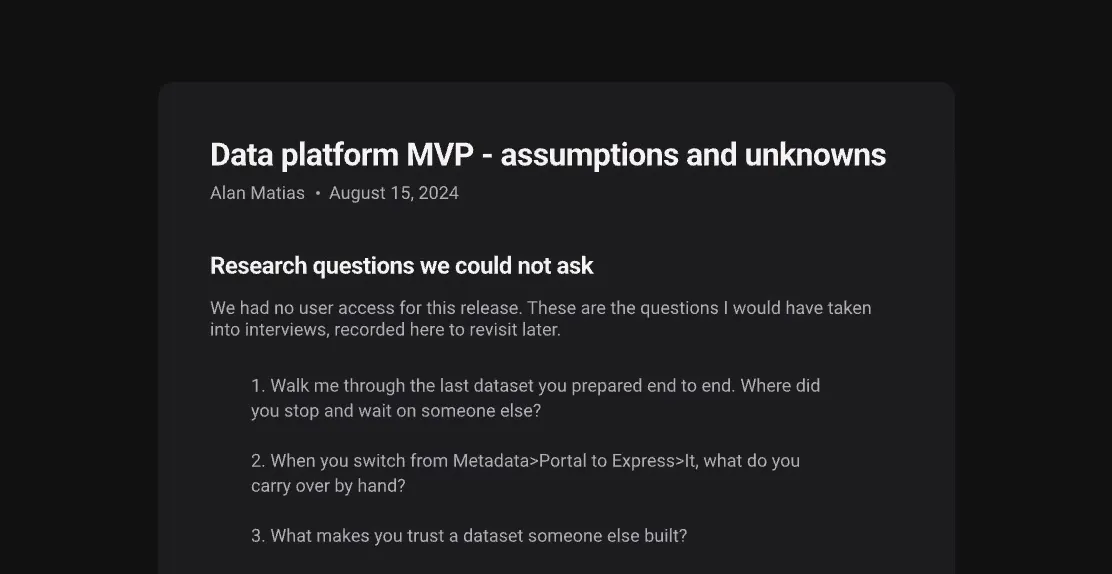
Still, that left a lot of unknowns. So I wrote out the research questions I would have asked, the hypotheses behind my assumptions, and kept moving. Writing this down made the gap in evidence visible to everyone instead of always being a tension point in discussion.
Making three products feel like one
Ab Initio had no formal design system, which meant that every product had its own styles and interaction patterns. To make one unified platform, there was a parallel effort to create our first design system: Honeycomb. As part of that huge effort, I led the design tokens work: from planning, alignment, implementation, and distribution.
There was already a shared color file — nearly 600 variables with low adoption, hard to theme, and not built to scale. On a small team, developers like the flexibility of personal processes, so I talked with engineers about what they wanted automated versus what they wanted to own themselves. That framed a token set large enough for most use cases, and small enough to stay consistent.
Impact: three products → one
We shipped a three-product workflow into one platform, on time for our customer. It was a huge success and proved the value of UX for Ab Initio, which later paved the way for a more complete platform experience.
Looking back
Because this shipped for a specific customer, I should have treated them as a primary stakeholder from day one. I had a Technical Account Manager close to them, but I treated the customer as a consumer rather than a partner. Instead of looping them in only at major milestones, I would have brought them into the initial scoping and requirements.